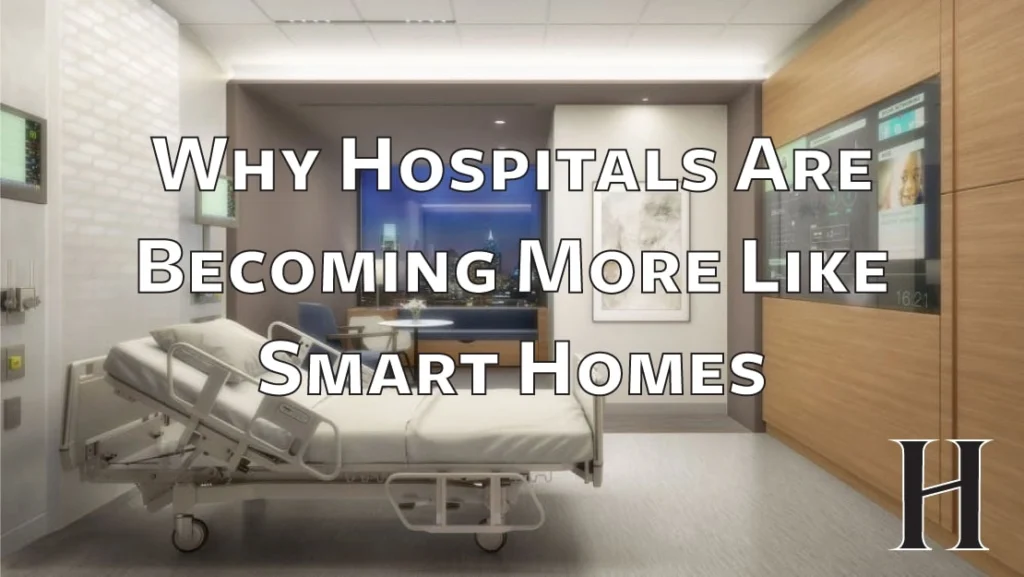

Hospitals used to feel cold, sterile, and impersonal—spaces built more for efficiency than comfort. But a transformation is underway. Walk into a modern medical center today and you might notice lights that adjust automatically, temperature-controlled patient rooms, voice-activated nurse alerts, and digital panels tracking everything from air quality to sleep patterns. In other words, hospitals are beginning to look a lot like smart homes.
This shift isn’t accidental. It’s the direct result of a technological boom that is reshaping healthcare from the inside out. What started as luxury consumer tech—smart thermostats, voice assistants, automated lighting—has evolved into a healthcare imperative. With hospitals facing staffing shortages, rising patient demand, and intense pressure to improve safety and experience, smart systems are no longer a perk. They’re becoming core infrastructure.
Today, we explore why hospitals are adopting smart home technology, what it means for patient care, and how this evolution is fundamentally changing the future of healthcare.
From Smart Homes to Smart Hospitals: A Pattern of Expectations
Smart homes didn’t just change the way people live—they changed what people expect from service environments. When patients can control lighting, temperature, and even home security from their smartphones, walking into a hospital with flickering fluorescent lights and a single wall outlet feels outdated.
Consumer tech accelerated healthcare tech adoption:
- Smart speakers → voice-activated call systems
- Smart thermostats → temperature-controlled patient rooms
- Wearable heart monitors → continuous clinical vitals tracking
- Security cameras & door sensors → fall-prevention and mobility alarms
Hospitals realized something fundamental: technology designed to increase comfort and safety in the home could do even more in a clinical space when paired with medical-grade AI and monitoring systems.
Patients may not say it out loud, but they now expect comfort as a standard, not a luxury—even in intensive care. The result? Facilities are investing in smart hospital technology not just to modernize but to meet a rising baseline of patient expectations.
Sensor-Driven Monitoring: The Silent Care Team
In smart homes, sensors detect motion, leaks, break-ins, or temperature shifts. In hospitals, they have more powerful responsibilities: preventing falls, flagging vital changes, and alerting teams to emergencies before human awareness kicks in.
Examples of Smart Hospital Sensors
- Pressure-sensitive beds that notify nurses if patients at risk attempt to stand
- Smart IV pumps that monitor dosing and fluid rates
- Fall-detection floors that trigger alerts when unusual movement is detected
- Air quality and infection-control sensors that analyze ventilation and particle density
Instead of waiting for alarms or manual checks, sensors create continuous streams of real-time health data. This shift from episodic to constant monitoring has reduced emergency escalation, improved response times, and significantly lowered preventable incidents like nighttime falls.
In effect, smart sensors function as an invisible clinical support team, always awake, always tracking, always learning.
AI and Automation: The Digital Workforce in Action
Staffing shortages, clinician burnout, and administrative overload remain some of healthcare’s largest challenges. Smart home-style automation, when integrated into hospital systems, acts as a multiplier—not a replacement—for human teams.
Key AI-Driven Smart Hospital Functions
- Predictive analytics to alert clinicians of sepsis or cardiac risk hours earlier
- Automated charting and voice-to-record systems that reduce documentation burden
- Digital triage tools handling intake questions and routing patients
- AI imaging diagnostics assisting radiologists in detecting abnormalities
Automation doesn’t diminish clinical expertise—it restores it. Instead of nurses running between tasks or filling out forms for half the shift, they can focus on patient interaction and complex care.
This evolution mirrors smart homes, where automation handles repetitive tasks like climate control, security checks, or lighting schedules. In hospitals, automation becomes essential because the stakes—patient safety, accuracy, recovery—are exponentially higher.
Smart Room Design: Comfort as a Clinical Tool
Smart home design has taught us something crucial: comfort isn’t a luxury—it’s a health lever.
Sleep improves immune function. Light affects mood and recovery. Temperature impacts pain, anxiety, and healing speed.
Smart Hospital Room Features
- Circadian lighting that mimics natural daylight to enhance rest cycles
- Voice-controlled environments for mobility-limited patients
- Touchless entry and sanitation systems
- Adaptive temperature, humidity, and airflow control
Imagine a recovering patient who can adjust room light levels from bed, lower noise-sensitive alerts at night, or request medication through voice assistant—all without triggering nurse call lights unnecessarily. This minimizes stress, speeds healing, and supports dignity.
Smart hospital rooms transform passive spaces into active care environments.
Telehealth and Remote Monitoring: Care Beyond Walls
Smart home technology paved the way for health monitoring outside clinical campuses. Telehealth, remote monitoring, and virtual nursing aren’t stopgap measures—they’re defining the future of care.
Hospital-at-Home Tech Parallels
- Smart home health kits tracking vitals and sending reports
- Wearables detecting early symptoms before patient awareness
- Connected glucose monitors, heart sensors, and fall detectors
- Mobile apps coordinating specialist care without transport
When post-operative patients can be safely monitored from home with continuous readouts, hospital beds free up, costs drop, and patient comfort skyrockets. Instead of admitting someone for observation, clinicians can observe them remotely, with the same sensor accuracy used in-hospital.
The shift isn’t about convenience—it’s about scalable, sustainable healthcare.
IoT Security and Data Privacy: Where Smart Tech Meets Risk
With smart systems come new vulnerabilities. Hospitals deal with far more sensitive data than smart homes—clinical records, bio-data, imaging, prescriptions, genetic data.
Core Security Priorities
- Encrypted device communication
- Tiered access privileges across hospital staff
- Endpoint vulnerability scans
- HIPAA-aligned sensor data collection policies
- Real-time network threat detection
Unlike smart homes where a breach might compromise family photos, a hospital network breach could expose genomic data, medical records, or device telemetry.
Hospitals adopting smart technology are investing heavily in cybersecurity frameworks because the cost of innovation is accountability.
Real-World Smart Hospital Examples
Mayo Clinic: Predictive Patient Monitoring
AI-integrated rooms and automated vitals tracking reduced code-blue events and improved response time.
Singapore’s Smart Health System
Nationwide IoT monitoring integrates patient data into unified platforms, enabling seamless hospital-clinic-home transitions.
Cleveland Clinic: Smart Surgical Suites
Robotic tools, AI imaging overlays, and automated documentation help surgeons operate with unprecedented precision.
These facilities aren’t futuristic showcases—they are blueprints for what hospitals globally will become.
Challenges and Controversies
No transformation comes without friction. Smart hospitals raise valid concerns:
- Will automation reduce human interaction?
- Can predictive algorithms misclassify or introduce bias?
- What happens when connected systems fail or crash?
- Do continuous sensors blur ethical boundaries of surveillance?
Transparency, policy development, and staff training remain essential. Technology without governance risks undermining patient trust.
But with thoughtful design, smart systems enhance rather than replace the human role, supporting caregivers rather than overshadowing them.
The Human Element: Technology Supporting, Not Replacing Care
Smart hospital technology works best when invisible—easing burdens, improving outcomes, and creating supportive environments without overwhelming patients with buttons, apps, or interfaces.
The future of healthcare isn’t a world where machines replace nurses. It’s one where sensors reduce false alarms, AI handles charting, automation cuts duplication, and clinicians return to what they do best: care.
Smart homes made comfort programmable. Smart hospitals make healing intelligent.
Conclusion: The Smart Hospital Era Has Arrived
What began as consumer luxury has become clinical necessity. Smart hospitals are not tech experiments but fully functional ecosystems where sensors, automation, AI, and predictive analytics blend into everyday operations.
Key Takeaways
- Smart home tech seeded patient expectations for comfort and control.
- Sensors and automation enhance safety, reduce falls, and speed response.
- AI enables proactive care and reduces documentation overload.
- Smart rooms create healing environments, not just treatment spaces.
- Telehealth and remote monitoring expand hospital reach to homes.
- Strong cybersecurity protects expanding digital endpoints.
Hospitals aren’t borrowing smart home tech—they’re redefining its potential.
Call to Action
Would you trust a fully automated hospital room?
How much comfort and control would you want during your stay?
Share your thoughts, experiences, and questions below—and if this glimpse into the future of healthcare resonates, pass it on. The transformation is already here. Now it’s time to discuss what comes next.