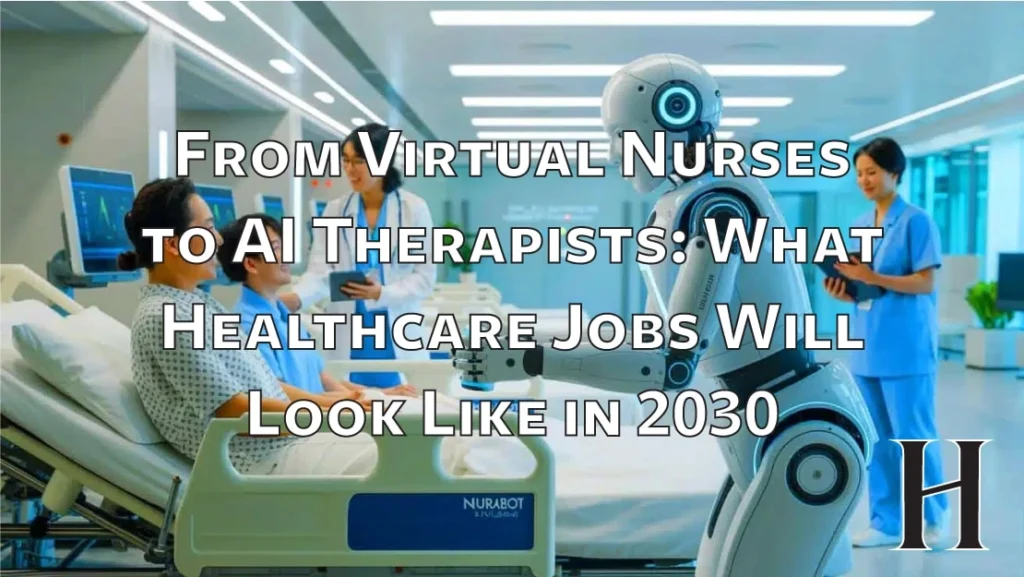

The waiting room is quiet. A patient checks in through a virtual kiosk and is greeted instantly—not by a human nurse, but by a calm, conversational digital assistant that reviews symptoms, updates medical records, and prepares the clinician for the visit. Meanwhile, in the mental health wing, an AI therapist leads a guided CBT session, monitoring tone and sentiment to adapt its approach. A human clinician oversees the process, stepping in only when needed.
This isn’t science fiction. It’s a preview of the healthcare workforce in 2030—a future driven by virtual nurses, AI-powered therapists, hybrid tech-enabled roles, and smarter workflows designed to support overburdened healthcare systems.
Healthcare is changing faster than ever. Staffing shortages are growing, patient needs are rising, and new technologies are reshaping how care is delivered. The question is no longer if AI and automation will transform the healthcare workforce—but how.
In this in-depth, forward-looking guide, we explore:
- Which healthcare jobs will exist in 2030
- How AI and virtual care will redefine clinical roles
- The new hybrid jobs emerging from AI-human collaboration
- The skills professionals need to stay relevant
- How ethical and regulatory frameworks will shape the future
Let’s look at what the future of healthcare work really holds.
The Forces Driving the Transformation of Healthcare Jobs
To understand where healthcare jobs are headed, we need to examine the powerful forces shaping the industry today.
1. Global shortages of healthcare workers
The World Health Organization projects a global shortage of 10 million healthcare workers by 2030—a gap driven by aging populations, chronic disease, clinician burnout, and limited training capacity.
AI, automation, and virtual care aren’t replacing jobs—they’re emerging to fill urgent gaps.
2. The rapid maturation of health technologies
Health tech has accelerated more in the last 5 years than in the previous 50.
Key developments include:
- AI diagnostics capable of reading medical images
- Natural language processing for clinical documentation
- Virtual assistants and chatbots for triage
- Wearable-based remote monitoring
- Digital therapeutics for mental health
- Robotics for surgery and care assistance
These systems are enabling tasks once handled only by humans.
3. The rise of digital-first patient expectations
Patients today expect the same convenience in healthcare that they get from banking or shopping apps:
- 24/7 access
- Instant answers
- Personalized information
- Shorter wait times
- Virtual care options
Virtual nurses, AI therapists, and automated workflows are emerging to meet these expectations.
4. A data explosion like healthcare has never seen
Wearables, EHRs, sensors, imaging equipment, and apps generate massive amounts of clinical data—more than humans alone can sort and interpret. AI is becoming essential to make sense of it.
These forces are converging to create a new kind of healthcare workforce.
The Rise of Virtual Nurses: More Than Chatbots
If you imagine virtual nurses as simple chatbots, think again. By 2030, virtual nursing will be one of the fastest-growing roles in the industry.
What Virtual Nurses Do in 2030
Virtual nurses handle a wide range of responsibilities, including:
- Patient intake and triage
- 24/7 symptom assessment and guidance
- Medication reminders and follow-ups
- Post-hospital discharge support
- Remote monitoring alerts
- Patient education and lifestyle coaching
In other words, they don’t replace human nurses—they extend them.
Why Virtual Nurses Are Becoming Essential
Healthcare systems worldwide are struggling with:
- Nurse shortages
- High turnover
- Growing administrative burdens
- Patient expectations for rapid communication
Virtual nurses help solve these problems by handling routine interactions, allowing human nurses to focus on higher-value clinical care.
Real-world examples already in action
- Some hospitals now use virtual command centers to support bedside RNs.
- AI-based triage tools help determine whether patients should seek urgent care, telehealth, or home care.
- Large health systems deploy virtual nurses for post-discharge check-ins to reduce readmissions.
By 2030, these systems won’t just be optional—they’ll be fundamental.
AI Therapists: The Future of Mental Health Support
The mental health crisis has outpaced the supply of trained professionals. AI-powered therapists are emerging as a critical tool for expanding access to care.
AI therapists are not replacements—they’re force multipliers
By 2030, AI therapists will help with tasks like:
- Conducting structured CBT sessions
- Monitoring patient mood and language patterns
- Guiding meditation, exposure therapy, or coping exercises
- Identifying early signs of crisis
- Offering 24/7 support between human-led sessions
This frees human therapists to focus on complex emotional, relational, and trauma-based cases.
Why AI mental health tools are growing rapidly
- Mental health demand continues to climb
- Many regions lack trained clinicians
- Patients increasingly accept digital support
- AI can provide real-time mood tracking and intervention
Early digital therapeutics already show effectiveness. By 2030, AI therapists will be embedded in everyday care.
Human clinicians remain the decision-makers
Even as AI grows in capability, humans remain essential for:
- Diagnosis
- Treatment planning
- Crisis intervention
- Empathy-driven therapy
- Ethical oversight
AI extends reach. Humans provide connection.
Emerging Hybrid Roles: Where Humans and AI Work Together
One of the biggest shifts by 2030 isn’t replacing jobs—it’s creating entirely new ones.
Here are the hybrid roles we’ll see more of:
1. AI Care Coordinators
These professionals oversee AI-generated care plans, validate recommendations, and ensure continuity across care settings.
They act as the bridge between AI output and human decision-making.
2. Clinical Data Interpreters
With vast amounts of wearable, sensor, and EHR data available, these specialists:
- Interpret AI insights
- Communicate data trends to clinicians
- Ensure data is clinically relevant
- Identify anomalies AI may miss
This role blends data analytics with medical knowledge.
3. Wellness Tech Coaches
As consumer health tech explodes, patients need guidance on:
- Using wearables
- Interpreting biometrics
- Choosing the right apps
- Setting health goals
Health systems will increasingly hire coaches to improve patient engagement and outcomes.
4. Digital Clinic Managers
These leaders run virtual-first healthcare operations, supervising everything from online consultations to remote diagnostic teams.
5. Robotics-Aided Care Specialists
Using robotic assistants for mobility, lifting, cleaning, or drug dispensing requires new skills—someone must program, maintain, and integrate them into workflows.
These roles blend human strengths—empathy, judgment, creativity—with AI’s strengths—speed, scale, and precision.
Jobs That Will Evolve, Not Disappear
AI anxiety often focuses on job replacement. But most healthcare roles are transforming, not vanishing.
Doctors
AI will assist with:
- Diagnosing
- Imaging interpretation
- Charting
- Treatment selection
Doctors will spend more time on patient relationships, complex decision-making, and ethical considerations.
Nurses
AI will take over tasks like:
- Documentation
- Patient tracking
- Medication reminders
- Pre-visit assessments
Nursing will become more specialized, relational, and patient-centered.
Therapists
AI handles structured sessions and monitoring. Human therapists handle empathy, context, and emotional nuance.
Pharmacists
Automation and AI streamline dispensing and drug interactions. Pharmacists shift toward advising, counseling, and optimizing treatment plans.
Administrative roles
Scheduling, billing, and documentation become automated—administrative staff shift to coordinating patient experience and operational support.
Across the board, the theme is clear: humans handle care—AI handles complexity.
Ethical, Legal, and Trust Challenges Ahead
As AI and automation reshape healthcare jobs, several challenges must be addressed.
1. Data Privacy
Health data generated by wearables, apps, and sensors needs strong governance and patient control.
2. Algorithm Bias
If AI is trained on biased data, its decisions can disproportionately affect underrepresented groups.
3. Transparency and Explainability
Clinicians need AI tools they can understand and trust—not black boxes.
4. Liability
Who is responsible when AI makes an incorrect recommendation?
Regulators must define clear accountability frameworks.
5. Patient Trust
Patients may hesitate to rely on AI for diagnosis or mental health support. Trust must be earned through transparency and proven outcomes.
The future depends on addressing these issues early and responsibly.
Real-World Early Adopters Proving the Future Is Already Here
While 2030 sounds far away, many organizations are already pioneering AI-driven care models.
Virtual nursing programs
Major hospitals use virtual nurse “command centers” to help bedside teams with triage, education, and monitoring.
Digital mental health platforms
AI-driven CBT tools and digital therapeutics are already FDA-approved for conditions like insomnia and substance use.
AI triage in telehealth
Virtual symptom-checkers help route patients to appropriate care, improving efficiency and reducing wait times.
Remote patient monitoring (RPM)
Wearables track heart rate, temperature, oxygen levels, and activity—feeding data to cloud platforms monitored by hybrid AI-human teams.
These are small previews of what healthcare will look like at scale by 2030.
The Skills Healthcare Professionals Need by 2030
As the workforce transforms, professionals must adapt. Here are the skills that will matter most:
1. Data Literacy
Understanding biometric data, AI reports, and digital dashboards will be crucial.
2. Digital Fluency
Comfort with wearables, apps, telehealth systems, and robotics integration will be expected.
3. AI Collaboration
Clinicians must know when to trust AI—and when to override it.
4. Critical Thinking & Problem-Solving
AI provides insights; humans provide context and judgment.
5. Empathy and Communication
The more automated healthcare becomes, the more human connection matters.
6. Ethical Reasoning
Healthcare workers will navigate new moral and legal questions around AI-driven decisions.
Upskilling and reskilling are the keys to thriving in future healthcare careers.
Conclusion: The Human Heart of a High-Tech Healthcare Future
By 2030, healthcare will look very different—but not in the dystopian way some might fear.
AI therapists, virtual nurses, digital clinics, automated workflows, and hybrid AI-human teams will make care more accessible, efficient, and patient-centered.
But even in a highly digitized system, the heart of healthcare remains human.
Technology enhances care—humans give it meaning.
As we prepare for the future, one question remains:
How will you adapt, upskill, and position yourself for the new era of healthcare?
Your move today shapes the healthcare workforce of tomorrow.